I was looking at my Turkey gallery the other day—that is, the real life gallery in my breakfast area, and not the digital online representation—and I realized that since I completed those works in the fall of last year, I’ve learned new ways of creating a vintage photo effect. In fact, I believe more strongly in my newer techniques than in the one I used for those prints (which was basically just invoking a “Sepia” effect in a photo editing program). I understand the technical details of the newer process and confirm its philosophical integrity, and I feel the end result has an more authentic look*. So, just for fun, I decided to go back to the source image (the captured “bits” of light) for one of the pictures in the collection and create a new version of the print based the skills I’ve more recently adopted. Here are the results, side by side (you can click on each of them to get a larger view):
Current Version

New Version
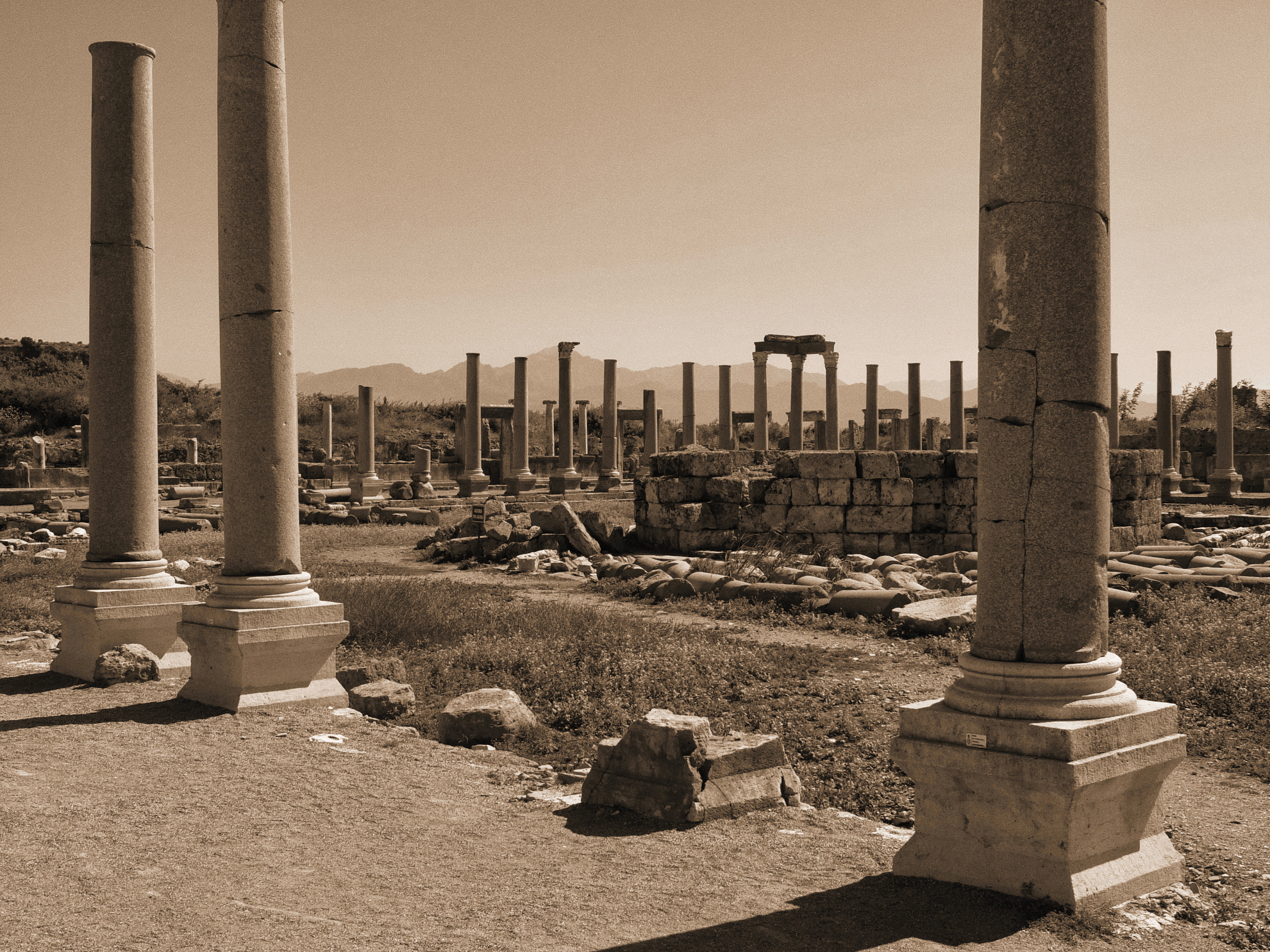
The new version of the print has a different, more serene, toning, as well as some film-grain added (apparent if you enlarge the image). I actually think it looks more like a true vintage photo, both at normal scale as well as at closer zoom. But more importantly, I think it better captures the mood of the location (the ruins of Perge) and the conditions of my visit there, as I remember them.
So the question is, what to do about it. Do I go and update all of the prints in my gallery, because I think I have the capability now to create a more refined and genuine feeling? Or do I accept (or better yet, embrace) that the existing gallery was a set of works done at a time and a place in my life, taken to a level of completion and expression that was meaningful and fulfilling to me, and be satisfied with that?
The answer to me on this is actually pretty easy. I love the works as I created and installed them nine months ago. Even if I would do it differently now (if it were for the first time), I remember the contemplative and emotional process I went through in making the choices about the design of the gallery (including supplanting the solarized Chicago images, and then details about the margins, the framing, etc.) as well as the actual execution of it. I owe it to myself to respect that experience and that accomplishment, and to have no regrets.
I suspect that this issue of revisiting prior works, and contemplating rework of some kind, is something many artists (in any medium) must face and make decisions about at various times in their careers. Some may struggle with what to do (as well as with then doing it), whereas a clearer path (of either action or inaction) may come easier to others. For instance, I know that Hemingway careful considered what he was going write each day (generally, no more than 900 words or so), but then exhibited a commitment and loyalty to those words once set down. Fitzgerald, on the other hand, never felt like his writing was done; he would work and rework stories and chapters in his novels until his editor Max Perkins ripped the manuscript out of his hands, gave it a final edit, and took it to press. Similarly, Anton Bruckner never stopped reworking his symphonies (sometimes, substantially), even after several publications; he left behind a legacy of intense debate over what should be considered the authoritative versions of his works. There can be profound depth in artistic expressions that are ceaselessly reconsidered and redeveloped, but that disquiet is troubling to me (sez me, who often doesn’t stop editing his writing—though I’m claiming here that photos are different for me).
For all artists out there, I wish you peace in your acknowledgment and reflection of your life’s prior works.
* By “authentic”, I refer to closeness in feel with my inspiration for this Turkey gallery, which was a set of vintage photos of early 20th century exploration in Peru. The pictures were part of an exhibition at the Seattle Art Museum that I saw in October of 2013.
 Lumina Capta